
GoHighLevel vs Skool: Which Platform Scales Your Business Faster?
You searched GoHighLevel vs Skool because you are standing at a crossroads. One platform promises to run your entire business. The other promises to build a thriving community around it.
Most comparison articles simply list features. That does not help you. The real question is this: are you trying to build a system that drives sales, OR a space where your audience connects and learns?
If your focus is automation, CRM control, funnels, and predictable client acquisition, GoHighLevel is built for that.
If your focus is community engagement, clean course delivery, and simple paid groups, Skool delivers that experience better.
But the smarter decision is not about which tool sounds impressive. It is about which problem you need to solve first.
In this detailed guide, we break down GoHighLevel vs Skool with real pricing numbers, full feature tables, and practical use cases so you can choose with confidence instead of guesswork.
What Is GoHighLevel?
GoHighLevel (often just called HighLevel) is the ultimate “Swiss Army Knife” for business automation. It is an all-in-one marketing and business automation platform built specifically for agencies, consultants, and service-based businesses.
It was founded in 2018 by Shaun Clark and has grown into one of the most powerful white-label software solutions available in the digital marketing space.
At its core, GoHighLevel combines tools that most businesses would otherwise need to buy separately. You get a CRM, email marketing, SMS automation, funnel builder, website builder, calendar booking, pipeline management, reputation management, and course hosting all inside one dashboard.
The platform is designed so that agencies can resell SaaS products under their own brand name, which makes it a serious revenue-generating asset beyond just being a software tool.
GoHighLevel is not just a marketing tool. It is an infrastructure platform. When you use it correctly, it replaces tools like ClickFunnels, ActiveCampaign, Calendly, Twilio, and even basic membership site platforms.
It is built for results, focusing heavily on ROI (Return on Investment), pipelines, and conversion.
| NEVER MISS: How to Setup a GoHighLevel Account?
Key capabilities include:
- Building websites and sales funnels.
- Automating email and SMS marketing.
- Managing customer relationships (CRM).
- Hosting courses and memberships.
- White-labeling the entire software to sell it as your own (SaaS).
CRM and Pipeline Management
GoHighLevel CRM features allow businesses to track leads through custom pipeline stages. Each contact can be tagged, segmented, and automated based on behavior. Sales teams can monitor progress and move deals forward.
Funnel Builder
The funnel builder allows creation of landing pages, opt in forms, sales pages, and checkout flows. These funnels connect directly to the CRM, which eliminates manual data transfer.
| You MAY BE LIKE THIS: GoHighLevel vs ClickFunnels
Email and SMS Automation
GoHighLevel automation tools enable trigger based workflows. For example, when a user downloads a lead magnet:
- An email sequence begins
- A follow up SMS is sent
- The lead moves into a pipeline stage
- A task is assigned to a team member
This reduces manual work and improves response time.
Appointment Booking
The built in calendar system syncs with workflows. Reminders are sent automatically through email and SMS to reduce no shows.
Agency White Label Capability
GoHighLevel for agencies includes unlimited sub accounts under the Unlimited and SaaS plans. Agencies can rebrand the platform as their own software.
Reputation Management
Businesses can request reviews automatically and manage online reputation from one dashboard.
GoHighLevel SaaS Mode
The SaaS Pro plan allows agencies to resell GoHighLevel as a subscription product. This creates recurring revenue.
When we build automation systems for agencies, we often see that structured workflows reduce manual effort and increase lead conversion rates.
That is where GoHighLevel shows its strength. GoHighLevel clearly wins when automation depth and CRM power matter.
What Is Skool?
Skool is a community and online course platform founded by Sam Ovens in 2019. It was designed with one primary philosophy in mind: learning is better when it happens inside a community rather than in isolation.
The platform brings together three core elements.
=> It offers a community space where members can post, comment, and interact.
=> It offers a classroom where course content is organized into modules and lessons.
=> And it offers a calendar feature where community events, live calls, and group sessions can be scheduled and accessed by all members.
Skool became widely popular in the online education and coaching space because of its simplicity. Unlike many course platforms that bury students in a maze of menus and settings, Skool keeps everything on the surface.
Members log in, see their community feed, access their courses, and check upcoming events. The entire experience is clean and focused.
Key capabilities include:
- Community feeds (like a clean Facebook group).
- Classroom for hosting course content.
- Gamification (leaderboards, points, and levels).
- Event calendars for live calls.
- Native video hosting and a strong mobile app.
The platform is not trying to be everything. It does not have a CRM, it does not send SMS, and it does not manage funnels or pipelines.
It does one thing very well: build engaged, retained communities around educational content.
Course Hosting
Skool allows creators to upload lessons and organize them into modules. It is simple and easy to navigate.
Group Discussions
Community interaction is central. Members can post questions, comment, and engage inside the group feed.
Gamification Points System
Members earn points for activity. Leaderboards increase engagement and participation.
Membership Subscriptions
Skool membership pricing is straightforward. Each community requires a $99 monthly subscription.
Simplicity
Skool removes complexity. There is no advanced CRM, no funnel builder, and no multi step automation system.
For creators who want a focused learning environment, Skool offers clarity without technical distractions.
When comparing GoHighLevel vs Skool, Skool is more suitable for creators who prioritize engagement over automation.
Which Platform Is Better for You?
The answer depends on your business model.
If your main goal is sales automation, client acquisition, and scalable systems, GoHighLevel is the clear winner in the GoHighLevel vs Skool debate.
If your main goal is community building and simple course hosting, Skool is easier to manage.
Don’t panic! Talk to our expert. We will guide you if you are unsure which tool can scale your business with multiple directions.
Core Difference: GoHighLevel vs Skool
The biggest mistake people make in the GoHighLevel vs Skool debate is comparing features side by side without understanding intent.
These platforms were not built to compete directly.
GoHighLevel is a System.
It is built to handle the “business” side of things. It excels at the backend work getting people to buy, scheduling appointments, sending reminders, and managing leads. If you need to build complex automations where a user clicks a link, gets a tag, receives a text, and is moved to a new deal stage, GoHighLevel is unrivaled. It is the engine that drives revenue.
Skool is a Community.
It is built to handle the “product” side of things, specifically for knowledge businesses. It excels at keeping people around after they buy. If you want a place where your members post daily, cheer each other on, and compete to unlock new course modules, Skool is the winner. It is the living room where your customers hang out.
The “Hybrid” Reality.
Many successful businesses actually use both. They use GoHighLevel to market and sell (The System) and then send the customer to Skool to learn and connect (The Community). However, GoHighLevel has recently upgraded its own “Communities” feature to close this gap.
The Real Winner: GoHighLevel
If we are looking at business growth, revenue generation, and total control, GoHighLevel wins.
Who Should NOT Use GoHighLevel?
GoHighLevel is powerful, but it is not for everyone.
You should avoid GoHighLevel if:
• You do not plan to run funnels or paid ads
• You do not need CRM tracking
• You do not want to build automation workflows
• You only want a simple place to host one course
Many creators sign up for GoHighLevel expecting instant simplicity. Instead, they feel overwhelmed by pipelines, triggers, tags, and workflow logic.
If your business model is simple and you are not focused on scaling through automation, GoHighLevel may feel excessive.
Who Should NOT Use Skool?
Skool is elegant and simple, but it lacks operational depth.
You should avoid Skool if:
• You need structured lead tracking
• You want automated SMS follow up
• You run appointment based businesses
• You manage multiple clients as an agency
• You want white label SaaS revenue
Skool does not manage pipelines. It does not automate marketing. It does not replace CRM software.
If revenue growth and lead conversion are your top priorities, Skool alone will not solve that.
Need Help Setting Up GoHighLevel the Right Way?
Many businesses sign up for GoHighLevel but never unlock its full automation power.
=> Workflows remain basic.
=> Pipelines are messy.
=> Follow ups are inconsistent.
That is where expert implementation makes the difference.
If you want a fully structured CRM, automated sales system, and scalable SaaS setup, our team at NEXGHL specializes in done for you GoHighLevel automation systems.
Feature Comparison Table
Below is a comprehensive feature comparison between GoHighLevel and Skool to help you evaluate exactly what each platform offers.
| Feature | GoHighLevel | Skool | Winner |
| CRM and Contact Management | Full CRM with tags, custom fields, pipeline stages, and contact history | No CRM functionality | GoHighLevel |
| Email Marketing | Built-in email campaigns, sequences, and automation | No email marketing tool | GoHighLevel |
| SMS Marketing | Two-way SMS with automation triggers | No SMS features | GoHighLevel |
| Sales Funnels and Landing Pages | Advanced funnel builder with templates and A/B testing | No funnel builder | GoHighLevel |
| Website Builder | Full website builder with blog, ecommerce, and forms | No website builder | GoHighLevel |
| Course and Membership Hosting | Basic course hosting included | Full course platform with modules, drip scheduling, and progress tracking | Skool |
| Community Features | Basic groups feature, limited compared to Skool | Core community feed, commenting, reactions, and member profiles | Skool |
| Gamification | No native gamification | Points system, levels, leaderboard, and unlockable content | Skool |
| Live Event Calendar | Calendar for appointments and bookings | Community events calendar visible to all members | Skool |
| Appointment Booking | Advanced calendar with multi-user booking, round-robin, and integrations | Basic event scheduling only | GoHighLevel |
| Automation Workflows | Complex multi-step automation with conditional logic, wait steps, and triggers | No automation builder | GoHighLevel |
| Pipeline Management | Full visual pipeline with drag-and-drop deal tracking | No pipeline features | GoHighLevel |
| Reputation Management | Google and Facebook review requests, monitoring, and responses | No reputation management | GoHighLevel |
| Affiliate Management | Available in higher plans | Built-in affiliate program for community creators | GoHighLevel |
| White Label / Rebranding | Full white-label including domain, email, and desktop app | No white-label option | GoHighLevel |
| SaaS Reselling | Yes, with SaaS Mode on $497 plan | No | GoHighLevel |
| Marketplace / Discovery | No built-in marketplace | Skool marketplace for organic community discovery | Tie |
| Mobile App | Mobile app available for clients | Dedicated Skool mobile app for members | GoHighLevel |
| Analytics and Reporting | Advanced reporting across funnels, campaigns, and pipelines | Member analytics, course completion rates, and engagement stats | GoHighLevel |
| Integrations | Zapier, Stripe, Twilio, Mailgun, Google, Facebook, and hundreds more | Stripe for payments, limited third-party integrations | GoHighLevel |
| Payment Processing | Stripe integration for products, funnels, and subscriptions | Stripe for community memberships and courses | GoHighLevel |
| API Access | Yes, available on Unlimited and above | Limited API access | GoHighLevel |
| Customer Support | 24/7 live chat, Zoom support, and extensive community | Email support and Skool’s own support community | GoHighLevel |
| Free Trial | 14-day free trial available | Free tier available with one community | GoHighLevel |
| Setup Complexity | High: requires time and learning curve | Low: intuitive and fast to launch | GoHighLevel |
This table makes one thing very clear.
=> GoHighLevel is a business operating system.
=> Skool is a learning and community platform.
The overlap between them is intentionally minimal, which means the decision about which to use comes down entirely to your business model and your primary growth challenge.
Winner is: GoHighLevel
Don’t skip GoHighLevel free trial and experience the platform agencies use to capture leads, close deals, and build recurring SaaS revenue.
Pricing Comparison Table
Pricing is often the deciding factor. GoHighLevel offers tiered pricing based on features and usage, while Skool keeps it incredibly simple.
| Plan Name | Price | Key Features & Limits | Who is it for? |
| Skool Standard | $99/month | • 1 Group • Unlimited Members • Unlimited Courses • Native Video Hosting • Community & Chat • 2.9% Transaction Fee | Course Creators, Coaches, and Influencers who want a simple, flat rate. |
| GoHighLevel Starter | $97/month | • 1 Account • Unlimited Contacts • Full CRM & Funnel Builder • Course/Membership Hosting • Email & SMS Automation • 3 Sub-accounts | Solopreneurs, Small Business Owners, and Single-Client Agencies. |
| GoHighLevel Unlimited | $297/month | • Unlimited Sub-Accounts • API Access • Branded Desktop App • Everything in Starter • Unlimited Team Members | Marketing Agencies and Businesses with multiple brands. |
| GoHighLevel SaaS Pro | $497/month | • SaaS Mode (Resell GHL) • Rebilling (Mark up Email/SMS costs) • Advanced API • Agent Reporting | Agencies wanting to become software companies and generate recurring revenue. |
GoHighLevel Pricing: https://www.skool.com/pricing
Skool Pricing: https://www.gohighlevel.com/em-pricing
Hidden Costs Most People Ignore: GoHighLevel vs Skool
When comparing GoHighLevel vs Skool pricing, most people only look at the base subscription price. That is a mistake.
Let’s break down the real cost structure.
GoHighLevel Hidden Costs
GoHighLevel uses external providers for email and SMS delivery.
• SMS is powered by Twilio
• Email is powered by Mailgun
• You pay based on usage
For example:
If you send:
10,000 SMS monthly → expect around $75 to $120
50,000 emails monthly → expect around $35 to $80
These costs grow only when your revenue grows.
For agencies using GoHighLevel for coaches or local businesses, these costs are predictable and scalable.
Skool Hidden Costs
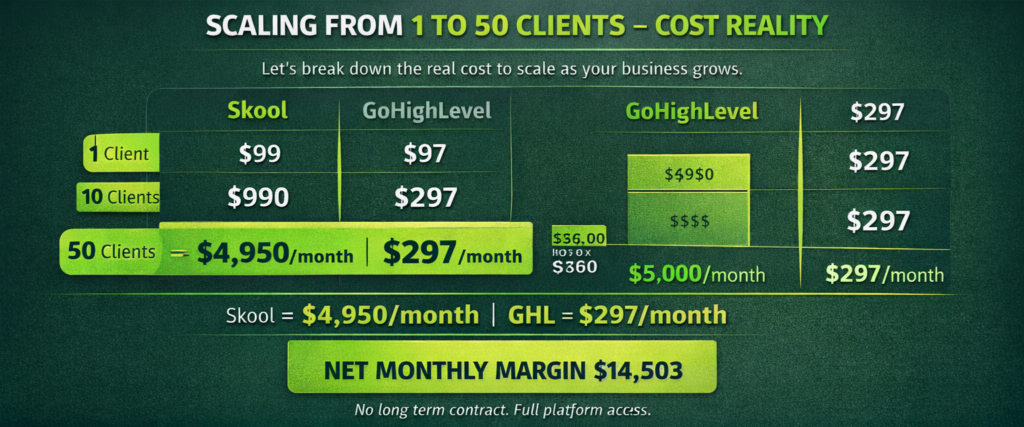
Skool pricing looks simple at $99 per month per community.
If you run:
5 communities → $495 per month
10 communities → $990 per month
Skool also charges 2.9% transaction fees via Stripe.
If your community generates $20,000 per month:2.9% fee = $580 monthly
This is why many agencies searching for the best platform for online coaching business eventually compare GoHighLevel vs Skool pricing more deeply before deciding.
Real Cost Example Comparison
Scenario:
You manage 5 client communities.
Skool Cost:
$495 per month
GoHighLevel Unlimited Plan:
$297 per month total
This is why agencies searching for a Skool alternative often move toward GoHighLevel.
Ease of Use and Learning Curve
Skool offers faster setup and simpler navigation.
GoHighLevel requires more configuration:
- Workflow setup
- Pipeline creation
- Funnel design
Beginners may prefer Skool. Advanced marketers benefit from GoHighLevel customization flexibility.
| NEVER MISS: GoHighLevel vs SalesForce
Scalability and Revenue Potential
When we talk about scaling, we are talking about your bank account.
Skool’s Revenue Model:
Skool scales engagement. You can manage thousands of members inside one clean community. The gamification system keeps activity high without constant manual effort. However, each additional community costs another $99 per month. If you manage multiple brands or clients, that expense grows quickly.
GoHighLevel’s Revenue Model:
GoHighLevel is designed to generate revenue.
- Lead Gen: It turns traffic into leads and sales automatically.
- SaaS Mode: This is the game-changer. On the $497 plan, you can resell GoHighLevel to your clients. You can charge a client $300/month for the software, and GoHighLevel charges you nothing extra. You keep 100% of the profit.
If you have 50 clients on Skool, you are paying for 50 groups ($4,950/month cost). If you have 50 clients on GoHighLevel, you pay one flat fee ($297 or $497/month), and you could be collecting $15,000/month in SaaS fees from them.
Revenue Impact Comparison: Before Sale vs After Sale
When people search for a GoHighLevel alternative to Skool, they often compare tools without understanding where revenue is leaking.
| Revenue Area | GoHighLevel | Skool | Best For |
| Lead Capture Automation | Yes | No | GoHighLevel |
| Sales Pipeline Tracking | Yes | No | GoHighLevel |
| SMS & Email Follow Up | Yes | No | GoHighLevel |
| Community Engagement | Limited | Strong | Skool |
| Course Completion Psychology | Basic | Strong | Skool |
| SaaS Reselling Revenue | Yes | No | GoHighLevel |
| Multi Client Profit Margin | High | Low | GoHighLevel |
If your revenue problem is happening before the sale, GoHighLevel is the solution.
If your revenue problem is happening after the sale, Skool is the solution.
This is the core difference between Skool vs GoHighLevel pricing value and long term scalability.
| Read This: Close vs GoHighLevel
Best For Coaches and Course Creators
If you are a coach or course creator, the right choice depends on how you sell.
If your audience already trusts you and you mainly need a simple, clean space to deliver your program, Skool is excellent. It removes technical friction and keeps your members focused.
However, if you are running paid ads, booking sales calls, or selling high ticket programs, you will likely need automation, CRM tracking, and follow up sequences. That is where GoHighLevel becomes essential.
Many creators start with community first, then realize they lack a proper system to scale sales. Others build complex systems first and later realize their students feel disconnected.
The smartest strategy is to identify your bottleneck, not your preference.
| Informational Guide: Hubspot vs GoHighLevel
Best For Agencies and Small Businesses
For marketing agencies and local small businesses (like gyms, dentists, or plumbers), the winner in GoHighLevel vs Skool is clear.
GoHighLevel is the undisputed king here. Skool lacks the fundamental tools a business needs to operate. A local business needs to capture leads from Google, text them back instantly, and book appointments. Skool cannot do this.
For agencies, GoHighLevel provides the ability to manage hundreds of clients from one dashboard. You can clone entire business setups (called Snapshots) in seconds. Skool has no agency features; you would have to log in and out of every client’s separate group.
If you run an agency, NEXGHL specializes in setting up these complex automation systems so you can focus on selling, not fixing tech.
Real Use Case 1: The Agency That Outgrew Skool
One digital marketing agency we worked with originally used Skool to host client training and onboarding materials. It worked well in the beginning because clients could log in, watch tutorials, and interact inside a clean community feed.
The problem appeared when the agency began scaling.
They were running paid ads for clients. Leads were coming in daily. But there was no structured CRM to track deal stages. Follow ups were manual. Missed calls were not being captured. Sales reps were using spreadsheets.
Revenue was inconsistent, not because traffic was low, but because systems were weak.
When we migrated them to GoHighLevel:
• Each client received a custom pipeline
• Every new lead triggered instant SMS and email follow up
• Missed calls automatically sent text responses
• Sales reps worked from a visual deal board
Within 60 days, appointment show rates increased. Response time dropped from hours to seconds. Closing rate improved because no lead was forgotten.
Skool did not fail them. It simply was not designed to manage revenue operations.
This is the key difference many business owners discover too late.
Real Use Case 2: The Coach Who Needed Engagement, Not Automation
Now let’s look at the opposite case.
A mindset coach came to us using GoHighLevel for everything. Funnels were working. Leads were coming in. Sales calls were booked automatically. Revenue was stable.
But inside the membership area, students were quiet.
They watched content. They rarely interacted. Completion rates were low. There was no social energy.
The issue was not automation. The issue was engagement psychology.
When this coach moved delivery into Skool:
• Members started posting daily wins
• Gamification points increased activity
• Leaderboards created friendly competition
• Peer to peer support reduced refund requests
Completion rates improved because students felt seen and involved.
GoHighLevel generated the sale. Skool strengthened retention.
Different problems. Different tools.
Real Use Case 3: The Hybrid Model That Scales Fastest
The strongest businesses often use both strategically.
One high ticket coaching program uses this exact flow:
Step 1: Traffic runs to a GoHighLevel funnel
Step 2: Lead enters CRM and receives automated nurture emails
Step 3: Sales call is booked through GHL calendar
Step 4: Client payment is processed
Step 5: Client receives access to Skool community
Why does this work so well?
Because each platform is doing what it is best at.
GoHighLevel handles:
• Lead capture
• Automated follow up
• Sales pipeline tracking
• Revenue reporting
Skool handles:
• Community bonding
• Course progression
• Group accountability
• Long term engagement
This hybrid approach removes friction on both ends of the customer journey.
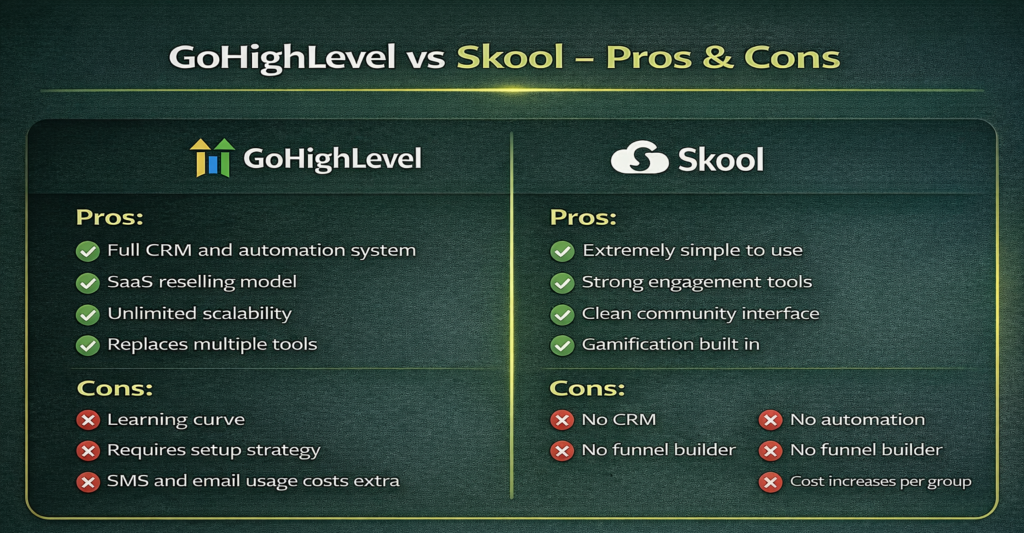
Pros and Cons: GoHighLevel vs Skool
Final Expert Recommendation
So, who wins the GoHighLevel vs Skool showdown? After comparing everything side by side, here is a clear, experience-based recommendation based on business type.
The Verdict:
- Go with Skool if you are an influencer or community leader who already has an audience and simply wants a vibrant, easy-to-use home for them. It is the best “Community” platform on the market today.
- Go with GoHighLevel if you are a business, agency, or coach who needs a complete “System” to get leads, close sales, and automate operations. It is the best “Business” platform on the market today.
Still feeling stuck between the System and the Community? You don’t have to guess.
The team at NEXGHL specializes in GoHighLevel strategy, automation, and implementation. Whether you are starting from scratch or migrating from another platform, getting a clear setup strategy from the beginning saves you significant time and money.
Would you like me to analyze your current business model and tell you exactly which setup will double your efficiency? Book a Free Consultation Call with Our Expert to start the conversation.
Frequently Asked Questions
Is Skool a CRM?
No. Skool does not include CRM or sales pipeline features.
Can GoHighLevel replace Skool?
GoHighLevel includes community and course features, but Skool currently offers stronger engagement and gamification.
Which is cheaper, GoHighLevel or Skool?
For one group, Skool is cheaper at $99 per month. For multiple clients or brands, GoHighLevel becomes more cost effective.
Can you use GoHighLevel and Skool together?
Yes. Many businesses use GoHighLevel for sales and Skool for delivery.
